

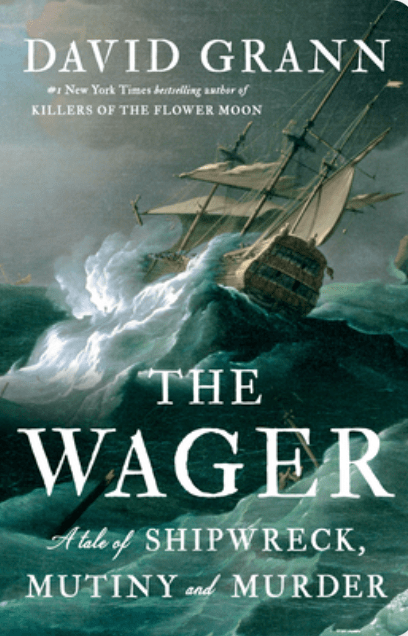
Title: The Wager: A Tale of Shipwreck, Mutiny and Murder
Author: David Grann
Genre: History, nonfiction, adventure, true crime
What It’s About:
David Cheap always dreamed about being the captain, and was part of the British Mission to circumnavigate the world during the War of Jenkins’ Ear. The mission started out with retrofitting several ships in to man-of-war ships, with cannons and re-patching the wood. Many of the ships could sink before they ever left port, due to the variety of infestations—worms that ate through wood, rats that ate through hemp materials and cotton canvases made for sails, and sicknesses of the many seamen onboard the ship as it awaited to leave. So David Cheap had his concerns, especially knowing that they have to make it around Cape Horn into the Pacific to chase the Spanish Galleon laden with various valuable goods—gold, silver, and more. As the mission contained several ships including the Centurion, and the Wager, a former East Indies trade ship that was retrofitted to be a man-of-war, they needed enough manpower to manage the ships for the long term, though it was decided that they wanted to double the amount of people on board. As they couldn’t find enough shipmen, press gangs started going around and kidnapping men who looked like they were sailors/seamen—hands with tar on them, striped shirts and pants made of a certain material that was made for living on the ship. They even took men coming off of merchant ships before they even had a chance of seeing their families to press them into the service of the ships on this mission, but many men decided to abandon their posts while the ships were moored and waiting for other ships to get ready—they were already getting ill, and the length of time it took to retrofit these ships was a bad omen, something that the seafarers believed in, being the superstitious bunch they were. Because they were so pressed to have the men, the navy took veterans from their veteran homes and brought them onboard the ships—all of them knew that they would be going to their deaths, never to return back to the United Kingdom.
Eventually, they left port in the United Kingdom, and along the way, they encountered another ship—thinking that it was the Spanish, they were prepared to go for a fight, but luckily it turned out to be a trade merchant ship, so they went on their way. They made a stop off the coast of Africa, to add provisions, but then needed to make their way out of the port in total darkness as their mission had become known to the Spanish, and they were being chased by Spanish Admiral Jose Alfonso Pizarro. They made it to Madeira, Brazil, then onto another stop in Argentina, losing some of their men to scurvy—a disease created aboard ships by the lack of vitamins and fresh vegetables/ fruits—and other illnesses. As a result, David Cheap was now made the Captain of the Wager, after the loss of the previous captain. As the group made their way through Cape Horn, two of the ships in the contingent returned upon entering the choppy waters, with the captains potentially deciding not to risk the ship, but the Wager, the Centurion and three other ships made their way through Cape Horn. In one instance, it almost looked as if the Wager would be lost to the ocean, as a shipwreck, but David Cheap masterfully directed his men aboard the ship to avoid collision with the rocks. Some of the men, including William Bulkeley, the gunner of the ship, and John Byron, then a sixteen year old who joined to make something of himself and would be the grandfather of the writer George Bryon, were impressed by Cheap’s tenacity and calm demeanor under pressure.
As the group made their way around the coast of Chile, there was thick fog and the Wager was separated from the group. At some point, Bulkeley sighted land, and made a note of that to the second in command, who chose not to say anything to the Captain who was under the effects of opium having been hurt on board. They crash against the surf, and though the captain is the last to leave, they finally get him out, even though there are some men on the ship that are refusing to leave the ship—these men would later become the instigators of trouble.
The men found themselves on a desolate island, and there is one house-like structure, that Cheap takes over as the Captain. Everyone else, especially those who are not able to fit into the structure, are left to sleep in the rain and the mud. At some point, Cheap has the men trying to salvage whatever they can from the ship so that they can live, and they eat wild seaweed and wild onions for food, especially after they get poisoned from bad flour. Eventually a small town develops, and a group of boisterous men secedes from the main group into their own section a few miles down from the base that they have created. These men, as well as some of the men from the camp, steal food from the tent containing supplies. At some point, one of the men gets disgruntled with the rationing of the food that he protests to the Captain, who in turn shoots him killing him.
Time goes on, and William Bulkeley is the only one who is writing a logbook of what is happening, as all of the logbooks from the ship have been either destroyed or partially destroyed—pages ripped out as if to hide the true account of what happened. He has always kept one as the gunner of the ship for his own purposes, and he does continue it once they are on land. He notates the ones that they have lost, and the events that transpired—as many men perished from lack of food, and the cold. Bulkeley tries what he can to get them out, including collecting and creating his own provision tents and ammunition, while Cheap wallows in his losses and that of his capitancy. This causes the base camp to have two factions, and it fractures further into those two factions after the Captain kills the man. Bulkeley carefully crafts things and has conversation so that he can’t be accused of mutiny, but ultimately gets the help of the Second Lieutenant, who when faced with Cheap, rescinds his accusation against the Captain as Cheap not being fit. They try a second time, and they make the second lieutenant the Captain on their faction. By this time, they have reconstructed and updated some boats thanks the the idea of the carpenter who said that he could remake them. They had also had help from indigenous peoples of the area, the Kawesar, who had come to the island as part of their migratory patterns. The castaways had given the indigenous peoples some gifts, and in return the people brought them food and living, but they ultimately deserted the group of castaways when they felt the tensions rise.
Eventually Bulkeley had found a way back to England—he had read the logbook of a previous captain who had traveled through the Strait of Magellan, and he convinces a group of them to leave, amongst which is Byron. The boy turns back after they get stuck in the cave, choosing to return to his Captain despite deserting them. Bulkeley’s group carries on, eventually making their way through the Strait of Magellan, past an Island where they leave another group of men behind because their rudder breaks in the water, and then into Rio Grande, where they are welcomed with surprise and great interest. The Second Lieutenant flees to England, and Bulkeley finds out that he means to make it Bulkeley’s fault that they mutinied. So he also heads home along with the remaining men, and faces the courts, but he chooses to publish his logbook, which is of great interest to the English people.
In the meantime, Cheap and his remaining men try to make it to Chiloe, but they are not able to make it through with the ship and the rough waters, so they turn back. Another group of indigenous peoples —Cano—finds them and one of the men speak Spanish, so the castaway communicate with them that way and they get help leaving the island with the indigenous peoples. Eventually they make it to Chiloe with the help of the Cano, and after suffering losses of some infantrymen—four of them who had been left behind. Unfortunately, they become prisoners of war by Pizarro and his men, but after the War of Jenkins’ Ear ends, they are sent home, where they encounter the story circulated by Bulkeley. The third group of castaways also make it home after having been abandoned by Bulkeley and his men, and have their own story to tell. They are all called into the Court Martial to give their accounts and the truth.
Anson had traveled the coast of Chile and eventually onto the Philippines, and China. There, he encountered a Spanish Galleon, and after an intense battle, he captured the ship along with its goods, thereby returning home a hero.
At the court martial, the men were only asked if the leadership had been at fault for the shipwreck. Every single person, including Bulkeley who had been overly critical of Cheap in the end of his time at the island, said that it wasn’t, as if they had sensed that this was a second chance at freedom. All of them walked away without any repercussions and went on to lead different lives—Cheap continued to be the Captain of a different Man of War, Anson went on to become the Vice Admiral and later the Father of the Navy for all the changes he brought into the British Navy, and Bulkeley went to the United States where he published another copy of his logbook from the Wager, but then seemingly disappeared.
My Thoughts:
I am not one for history books, but this one was certainly one that I decided to read because it was recommended to me. Of course, every sort of history based book will feel a bit dry to me as written because it sticks to facts, but my goodness—I learnt so many interesting facts about ships and seafaring in the 1740s, including how some of the expressions such as ‘under the weather’ came about. It was definitely an interesting book to read about how the Wager found itself shipwrecked and what was the outcome of the court martial when everyone finally returned home—which basically boiled down to the British Navy choosing to fry other fish than this one when they needed the support of people at home for the war that they were waging against the Spanish. That said, the fact that these men went through on these ships—ones that could just sink at the harbor with all the issues that wooden ships had at the time—is astounding. I cannot imagine myself in those kind of conditions or wanting to be in those kind of conditions, and getting sick. It makes sense now why it was so dangerous and why many people died at sea—scurvy, spoiled food, not enough space to sleep or what not, and add onto it all the rocky seas, and crazy tempests of whether, where you would be lucky if you even so much as made through it. And it contrasts so much with the romanticized version of ships and seafarers in movies like the Pirates of the Caribbean. Even the battles on sea did not look as beautifully choreographed or as dramatic as they show in these movies. I think that if you are interested in learning some sort of history about how things were on a ship in the 1700s, then this would be a lovely read. If you’re not into history and learning facts, skip this book for something else.
Discover more from The Girl with The Red Backpack
Subscribe to get the latest posts sent to your email.

