
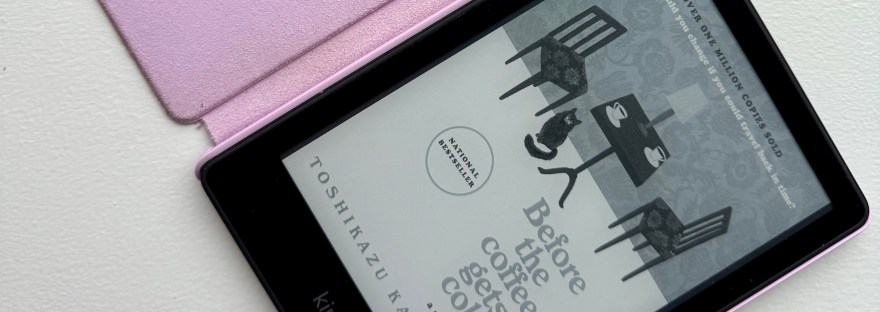
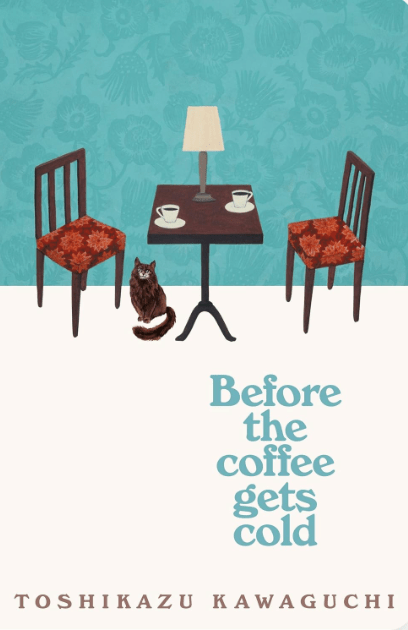
Title: Before the Coffee Gets Cold
Author: Toshikazu Kawaguchi
Genre: Fiction, fantasy, Magical Realism
What It’s About: In the first story, Fumiko Kiyokawa meets with her boyfriend Goro as they have to talk and she thinks that he will be proposing to her. They were to meet up at a certain cafe, but instead went to this little hidden cafe that reminds Fumiko of a song, and it is a cafe that has an urban legend that people can go to the past. At the cafe, Goro ends their relationship instead of proposing, because he had received his dream job at a company in the United States, and Fumiko is so confused. A week later, she revisits the cafe, and tells the ladies there—Kazu and Hirai—the story, then asks Kei to send her back to the past. There is a man sitting at a counter reading a travel magazine and taking notes, as well as a woman in white reading a book. Hirai leaves after making fun of Fumiko’s situation, especially when Fumiko hears the rules about going to the past. She had thought that she would be able to prevent Goro from leaving her and going to the United States by going to the past, but it turns out that the cafe has several rules: Going to the past changes nothing in the future, you can only meet the people who have been in the cafe before, you can only sit in one chair (currently occupied by the woman in white), and you have to finish drinking the coffee before it gets cold. Fumiko tries to get the woman in white’s attention, so that she could get a chance to sit at the chair and go to the past, but when the woman ignores her, Fumiko forcefully tries to get her out, only to get cursed. The curse gets lifted when Kazu brings some coffee for the woman. So Fumiko sits down and waits, but then realizes that a man—Fusagi is his name—is also waiting for the chair and knows that it wouldn’t be fair for her to take it when he has been waiting for it. There is a woman who comes to meet him, Kohtake, and he leaves with her when he realizes that the woman in white won’t leave anytime soon. To Fumiko’s luck, the lady in white leaves her seat to use the restroom shortly thereafter, so she goes to the seat and gets told that she has to drink her coffee while in that seat before it gets cold and return to the future by the time she finishes, otherwise she will become the ghost.
Fumiko drinks her coffee and is transported to the past, to the exact day that she and Goro had their last conversation. She had been determined to tell Goro that she cares for him and she wants to stay, but realizes that she cannot stop him from pursuing his dream—it had been what he had been striving towards. They talk again, and this time Goro reveals that he has been insecure about their relationship because of his scar and that she is too beautiful for him—he had seen the other men looking at her, so he thought she’d leave him. It breaks Fumiko’s heart because she never knew that is how he felt. As she begins disappearing back to the future, she hears Goro tell her that if she’d wait for him for two years, he’ll be back for her. She pays for her coffee and leaves.
In the second story, Kei saves a letter from a woman, who tells her that it is for Hirai. Once the woman leaves, Hirai jumps out from behind the counter, and tells her that she wants nothing to do with her sister and that she’s getting tired of her sister’s attempts to talk with her. She tells Kei to throw the letter out before walking out to take care of her bar across the street. Kei heads to to the back, and her cousin Kazu takes her place. Fusagi is sitting there reading his travel magazine, and waiting for the lady in white to leave her seat. Kazu is curious so she asks him who he is looking forward to see in the past, and Fusagi tells her that he wants to travel to the past to meet with his wife and give her a letter that is in a brown envelope. Kohtake comes into the cafe, and greets Fusagi, though he looks at her confused and asks her if they know each other, which sends Kohtake reeling—she had never thought that Fusagi would forget her so fast; he is her husband after all. He leaves, and Kohtake remains behind in the cafe, where Kazu and Kei speak with her, and Kei brings out the sake. They tell Kohtake that Fusagi wants to travel to the past to meet with her and give her a letter. This surprises Kohtake because no one knows that Fusagi cannot read or write at all—after all, they had met as young adults, and when she went to nursing school, she communicated with Fusagi via letters, where she told him about her life and things that she would be doing. Fusagi in return wrote her back with one sentence letters, and after awhile she thought that he didn’t have any interest in them. So she wrote a final letter to him and told him that if he cared he would respond with more than one sentence, and it would take two years for him to write a response, again in one sentence, asking her to marry him. When they talked afterwards, she realized that Fusagi did not know how to read or write, which is why it took him so long to respond and often he wrote based on what his impression of the letter was, not the actual contents of the letter. They did get married, he went on to become a Gardner, and they often traveled together to check out botanic gardens for him, because they brought him joy. The first time that Kohtake realized something was wrong, was when Fusagi came home one night really late—usually he was back at a certain time, and though she didn’t worry because sometimes he went out with coworkers—when he did come back, he apologized to her and told her that he got a little lost. Kohtake has been trained to recognize those signs, and so she took him to doctors where they found out he has Alzheimer’s. She had decided that even if he stopped remembering who she was to him, she would continue to take care of him as she is a nurse.
Ultimately, she gets convinced by Kei and Kazu to take the seat of the lady in white, who had coincidentally gone to the restroom, and go to the past. There, she meets with Fusagi, who is a year after his diagnosis of Alzheimer’s and asks him if he has something for her. He recognizes that she has come from the future, and when she reveals that she does know about his diagnosis, he looks crestfallen. She tells him that things to work out, and he gets better; at which point, he thanks her and gives her the letter from him. Kohtake returns to the present, and with Kei and Kazu by her side, she reads the letter in which Fusagi tells her that he appreciates everything that she’s doing for him, but he wants her to be his wife, and if she has to be his nurse, to let him go. She decides then and there, while all three of them are crying, that she wants to be called by her married name, not as Kohtake, because she is his wife and wants to continue being his wife. She had gone by the maiden name in order to not confuse Fusagi, when he started calling her that, but she asks the ladies to revert to her married name even in front of Fusagi.
In the third story, Nagare, the owner of the cafe is staring at the young girl who has arrived in the seat of the lady in the white dress. The girl tells him that she isn’t there to meet him at all, and when Kazu comes in there, she isn’t there to meet her either. Instead, she is there to meet Kei and wants to take a picture with her, before she goes back to her time. Kei, Kazu and Nagare are confused by the girl and who she might be, but they are so used to seeing people from the future show up that they don’t give it another thought. Kohtake shows up after her shift, and they start talking, with Kohtake asking them if they knew what happened to Hirai as her successful bar has been closed two days in a row. Nagare tells them all that he received an email from Hirai that her sister, Kumi, who had visited three days prior and left a letter with Kei, had died in a tragic car accident on her way back to the inn that she managed with her parents. They are all surprised when Hirai shows up, and acts as if nothing has happened, though Hirai reveals that her parents pretended that she didn’t exist at the funeral; they wouldn’t even look at her. There’s clearly some regret, and Kei tells her that she still has Kumi’s letter, which she hands over to Hirai, and Hirai reads quickly. This makes Hirai want to go to the past to meet with her sister, to talk with her again—as she had avoided her sister for over two years because of her sister’s “annoying” requests for her to come home. So Hirai rushes for the lady in white, and tries to get her off the stool once the lady ignores her, and ends up getting cursed. Kazu comes in and gives the lady the coffee, which lifts the curse on Hirai, and when Hirai prompts her to help her get into the seat, Kazu keeps offering the lady in white a cup of tea. By the 8th cup, the lady wants to go to the bathroom, bequeathing the seat to Hirai. Since Hirai is dealing with a lost loved one, Kazu gives her a timer in her coffee—one that will start to beep when the coffee starts getting cold—to make sure that Hirai comes back to the present.
Hirai travels to the past and talks to Kazu of three days prior. Kazu can tell that there is something wrong, but Hirai doesn’t want to tell her. Kumi shows up on time, and is surprised that Hirai is there and that she is acting strangely. Usually Hirai will run away from her, but today she is talking to Kumi and even smiling with her, something that she hasn’t done for a while. It becomes quickly obvious to Hirai that her younger sister doesn’t want to ask the question of Hirai coming back to the inn, because she’s shot her down so many times, so Hirai tells her that she would love to come back. This sets Kumi crying, that she has her own dream, and Hirai thinks that she had been selfish to abandon the family business because surely Kumi has her own dreams that she had to put on hold. Kumi then reveals that her dream has always been to run their family inn together with Hirai at her side, rather than alone. She then excuses herself to go to the bathroom to fix up her make-up from her crying. While she is in the bathroom, the alarm goes off and Kazu realizes what has happened—that Kumi has died, because the alarm clock is only given to someone when they’re dealing with a loved one’s loss. Hirai does not want to leave because she wants to see Kumi’s face again, but Kazu reminds her that she made a promise to Kumi, that she will run the inn with her, and whatever happens that causes Kumi’s death, she should go fulfill that promise. Hirai drinks the coffee and dissipates when her sister arrives back from the restroom looking for her. Kazu tells Kumi that Hirai had to run to take care of some things, but that she told her that she will follow through on her promise to Kumi. This results in the largest smile from Kumi that Hirai has ever seen. Upon her return to the present, Hirai decides to head back to her parent’s in and take over the work to fulfill her promise to her sister, not even thinking about her own popular bar.
In the fourth and final story, Kohtake comes into the cafe, while Nagare is there, and they talk about Hirai, who has sent an email to Nagare with pictures, where she is smiling and full of joy. Fusagi comes into the cafe as well, and Kohtake sits next to him, which unnerves him. It further bothers him when she tells him that she is his wife—it looks like today he doesn’t remember her, so she leaves him be, but on other days he does remember her as his wife. Fumiko is also there at the cafe, and she asks the owners whether or not people can go to the future. They tell her that yes they can go into the future, but that people generally do not go into the future because the future is yet unwritten. So they can’t say with any certainty that they will see what they are looking for and find out the information that they hope to find out, which is why it doesn’t appeal to many people. What Kazu doesn’t say to Fumiko is that since she had already gone to the past, she can’t use the cafe to go into the future too—people only get one chance. Kei shows up, looking extremely unwell, which makes Kohtake worry. She does eventually go lie down because she isn’t feeling well—after all, she has a very weak heart, where she was always hospitalized in her childhood, and her father had died from the same condition when she was nine. Kei did not understand why her mother smiled after her father’s death, but her mom told her that she was smiling so that her father would not see them looking sad, and would not be sad himself that he’s had to leave them.
Kohtake checks in on them later, and Nagare confides in her that he had told Kei to not go through with the pregnancy, but Kei would not be swayed to terminate. Kei comes out looking better, and admits that she knows that her body will not be able to handle the pregnancy, and agrees to check into a hospital the following day. That said, she decides that she wants to go to the future. It so happens that the woman reading the book decides to go to the bathroom right then, after looking at Kei, and Kei gets into her place. Kazu ignores orders from Nagare to let Kei do this, as going to the future could yield nothing, resulting in Kei deteriorating even more. But Kazu brings her the coffee set, and Kei tells her that she wants to meet on August 23rd, ten years from now at 3pm. She drinks her cup and is transported to the future, where she comes face to face with a man that has a scar from his right eye to right ear. The man looks at her, and eventually reveals that he is the manager of the cafe. He also tells her that both Nagare and Kazu are in Hokkaido at the moment, and Kei realizes that she will not have time for them to arrive to meet them. Eventually, a girl from junior high arrives and starts working at the bar—Kei recognizes her from the time that the girl had traveled to the past to see her and get a photo of her. The girl doesn’t know what Kei is talking about when Kei mentions that she has travelled to meet with her for a photo. A phone call comes through from Nagare, who reveals that there was a mixup on timelines—Kei had wanted to go 10 years into the future to meet at 1500 hours, but the coffee and chair took her to 15 years into the future at 10 am. He reveals to her that the girl in front of her, is her daughter. The girl disappears into the back, and Fumiko shows up. She tells her that she will get the girl, whose name is Miki, and that they should talk. Miki comes out and conversation is a little difficult, because neither know what to say to the other, but Miki does reveal that she had been looking forward to it, and had though that she would have much to tell her, but that right now she doesn’t know where to start. She thanks her for bringing her into the world, giving her a life, and calls her mom. The two share what little time they have and Kei realizes that the whole point of coming to sit at the cafe’s only seat that takes you to the past is that it maybe doesn’t change the past or the present, but it changes the heart, and the actions that you take as a result of that change of heart—-both Kohtake and Hirai couldn’t change the present, but they’ve found happiness in the present as well, with a change of heart.
Kei returns to the present, cries, and then the next day, she checks into the hotel. In the spring, she gives birth to a girl.
My Thoughts: While this is a very short book—about two hours and a half of reading time for me—it feels more like four short stories in one book. Of course, these four short stories are connected in that you have several core characters—Kei, Kazu, Nagare, Kohtake, and Fusagi—that keep appearing in each short story, and then Fumiko and Goro appear in the first and the last story. But they’re really four different experiences, and thereby four different, distinct stories that answer the question of “what would you do if you had the time of a coffee going cold to meet someone you’ve met in the past at this cafe?” One theme that is consistent across all of these stories is that the people whose perspectives we are reading have assumed something about their partners or siblings. They assumed the other person’s intentions—the way that Fumiko thought that Goro was making a choice between her and his passion, the way that Kohtake assumed that she had to take care of Fusagi as his nurse, and the way that Hirai had always assumed that she held her sister back from following her dreams. It explores, in reality, the things that people left unsaid, and the idea that there are many moments in our lives where what we say and what we truly want to say are two different things. Literally, if everyone in the book was honest with one another, stopped hiding behind whether or not they are being polite and mindful of the other’s assumed thoughts and feelings, and had deep meaningful conversation, at least three of the four stories would not exists. To me, this is a reminder to speak your heart, and learn to look at things from other people’s perspective, rather than hold onto things when you mean to say them, because you literally may not ever get another chance.
On the other hand, Kei’s story is a completely different spin—she knows she will die and never meet her daughter, but she wishes to know her. I realized that the girl who had wanted a picture with Kei in the third story was her own daughter, right from the outset. It wasn’t that difficult to realize that it was possibly her daughter because from the very first story we are told that Kei has a weak heart, and then there is a clue that she might be pregnant with her visiting the Ob/Gyn—that to me screams a high risk pregnancy where the risk of her not surviving childbirth is higher than normal, but that doesn’t mean that she couldn’t have had a good life and known her daughter. But once again, Kei just stumbles at what she wants to say—she wants to apologize to her daughter for bringing her into this world and leaving her motherless, but she never actually says that, and for a moment basically loses the potential of even getting to know her daughter until Fumiko steps in. And for someone who has thought that they would have shared a lot with the mom that they never met, but then clams up despite being a pretty outgoing kid, is a bit out of character.
Overall, it was an okay book, but I will definitely not be reading the rest of the series as it just irritatingly follows the same arch through the four stories, and it was a little challenging to get interested in the stories themselves. Besides, the rules around when you can go to the past are a little too strict, and it just creates unnecessary stress on everyone involved—I mean two of the main characters had gotten cursed by the dang ghost in the story because they were so adamant about getting into the seat asap.
Discover more from The Girl with The Red Backpack
Subscribe to get the latest posts sent to your email.

