

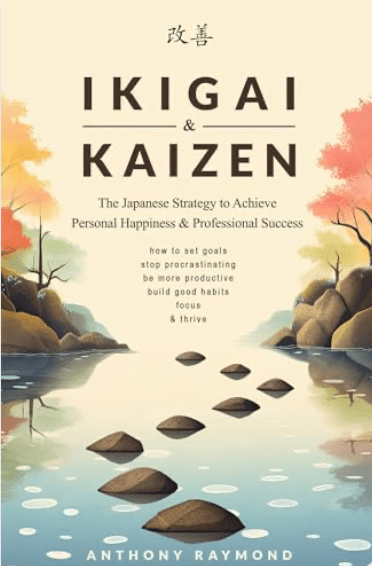
Title: Ikigai and Kaizen
Author: Anthony Raymond
Genre: Self-help, personal development, non-fiction
What It’s About: The author goes over the concepts of Ikigai, Kaizen, Lingchi, and Hansei—and how each of these concepts complement each other.
Ikigai is not just figuring out what you love, but asking yourself a series of questions including whether you can make money off of this thing that you love, whether this thing is needed by society, and more. It consists of finding an intersection between these several questions where all of them align, and so this thing would be your Ikigai—something that even if you fail at, or if you lose your business as an example, you would want to continue mastering and learning throughout your life.
Kaizen is all about continuous improvement, where we master the art of goal setting via a commitment to daily incremental progress. Rome wasn’t built in a day, but brick by brick by brick, day by day, the city came to be. The concept of Kaizen asks us to think about what is one “small” thing that we can do today that would enable and empower us to improve our lives? The author gives the example of going to the gym—many people fall off the gym after the first month, and cannot make that into a habit, mostly because they go all out. If instead, we were to take daily consistent action—10 seconds one day to do this one exercise, and then the next day we do it again, and then after a week of doing the 10 seconds exercises we increase the length or the weight, we are teaching our “lizard brain” (as the author terms it) to think of it as one other thing in our repertoire, and also build up a repository of psychological momentum that motivates us to advance to increasingly more difficult challenges.
Hansei is all about honest self-reflection, where it’s important to take a moment to critically analyze our behaviors and identify areas of our life that we can improve upon. One part of this concept is that even if you believe someone else is at fault for something, to take a moment and explore the idea that you may also be partially at fault here as well. This is not about placing blame on others but rather giving an honest appraisal of ourselves so that we can improve ourselves. And it’s only important to compare yourself to yourself, not to anyone else.
Lingchi—known as death by a thousand cuts—goes over how undesirable life outcomes do not originate from one single cause, but rather a series of small actions taken over longer periods of time. Usually one-off benign actions that done multiple times over a longer period of time adds up and impacts our life goals.
My Thoughts: I enjoyed this book—though it was a bit of a gentler theme on “extreme ownership” just showing how all of these concepts come into play. That said, the book only goes over these concepts, and leaves the reader to ponder and figure out the steps themselves on how to put this into practice. I wish there was maybe a section at the end or even throughout the book that gave us some “homework” to do— a series of exercises that could get us into the mind frame of Hansei for example, or exploring how we may have ended up with Lingchi (‘death by a thousand cuts’) cutting off our goals, or how we can maybe get back on track. The author does make mention that our perceived self will always be a ghost that we are chasing, and one we will never actually reach, but certainly there could be tips and tricks on how to align ourselves a bit more with the vision that we are seeing in our brain, or perhaps exercises that we could do to figure out that this perceived self is not what we truly want? The only time the author truly has an exercise is for the Ikigai section, but at the end of the book, he makes it clear that these four concepts work together in tandem. So if you only do 1/4th of the work, it’s not really clear how you’re supposed to figure out the remaining 3/4ths—all of these items;this self reflection on how these other three concepts show up through the decisions that we’ve made, it would really help. For me, overall this book is a 2.5 stars out of 5 because it just feels very lofty, idealized version of these concepts—a discussion of these concepts, but no meat and substance to help us work through to better understand ourselves. A lot of the points for consideration that the author makes get lost in the pages of writing and even in the quotes, so I’m not really sure how I’m supposed to act upon it, especially since this is a “self-help” or “personal development” book.
Discover more from The Girl with The Red Backpack
Subscribe to get the latest posts sent to your email.

